Five Curl Fixes for the Week You Start Wearing Hoods and Collars
Quick Answer: Hoods and collars flatten and frizz curls through friction and compression at the nape and crown - the two areas that were fine all summer because nothing touched them. The fixes are structural, not product-based: lift your hair out before the jacket goes on, choose smooth-lined collars over cotton or wool, park a claw clip in your bag for the walk, restyle only the nape rather than refreshing all over, and move your wash day so it does not land on the coldest morning of the week.
Something changes in the last two weeks of August. You leave the house at 7am and it is genuinely cool, so a jacket comes out for the first time in months. By eleven it is warm again and the jacket is over your arm.
Your curls have already registered this. Not as frizz everywhere - as a specific, annoying flat patch at the back of your head and a halo along the neckline that was not there in July.
That is friction and compression, in exactly two places, and it responds to five very specific fixes.

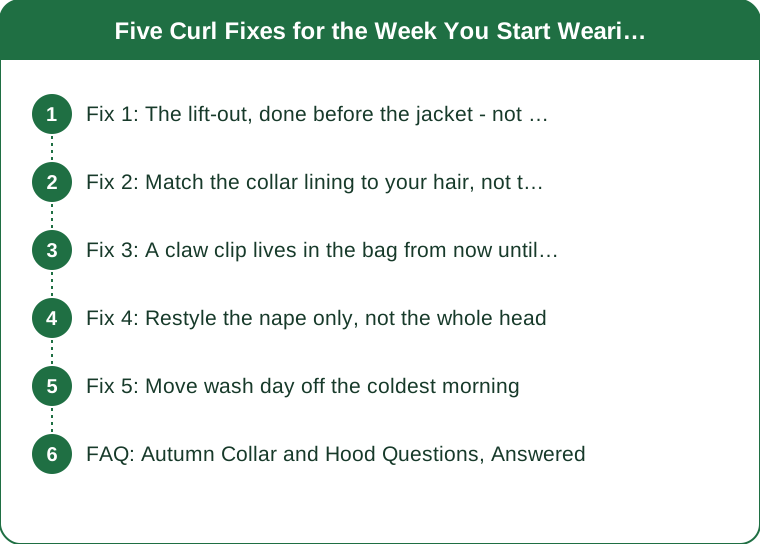
Fix 1: The lift-out, done before the jacket - not after
The single highest-return habit of the whole list, and it takes two seconds.
What happens: you put a jacket on over your hair, then reach back and pull the hair out from under the collar. That pulling motion drags the curls at the nape against the collar edge, which is the exact friction you were trying to avoid. You have made the problem while attempting to solve it.
The fix: gather your hair forward over one shoulder before your second arm goes into the sleeve. Jacket on, collar settled, then let the hair fall back. Nothing is dragged against anything.
With a hood, the same principle with an extra step: put the hood up before you lift the hair out, so the hair sits over the hood rather than compressed inside it. A hood down with hair trapped behind it is a rolled fabric tube pressing on your occipital curls for the entire walk, and it is the most reliable way to flatten the back of your head that exists.
This matters more for looser curl patterns, where the nape section carries less structure and flattens under less pressure. Tighter patterns tolerate more compression but pick up more friction frizz - so the same fix, for slightly different reasons.
Fix 2: Match the collar lining to your hair, not to the weather
Collar material predicts frizz better than anything you put on your hair.
A quick ranking of what late-summer outerwear actually does to curls:
- Satin or smooth polyester lining - best. Low friction coefficient, hair slides rather than snags. This is the same principle as a satin pillowcase, just vertical.
- Nylon shell jackets - good. Smooth, and typically the lightest option for this weather anyway.
- Cotton and cotton twill - mediocre. Absorbent, so it wicks moisture straight out of your hair, and the weave catches individual strands.
- Wool, fleece and sherpa collars - worst by a distance. High friction, high static, and fibre migration into the hair itself. If you have one favourite jacket that ruins your curls, it is almost certainly this one.
- Denim jackets - deceptively bad. Stiff collar edges concentrate pressure into a narrow line at the nape, which creates a crease rather than diffuse flattening.
The practical move: if your best transitional jacket has a rough collar, sew or clip a strip of satin inside the collar band. It sounds fussy. It costs almost nothing, takes ten minutes, and it is the difference between arriving with your curls intact and arriving needing a refresh.
Fix 3: A claw clip lives in the bag from now until spring
The commute is where the damage happens, and the commute is the part you can style around because nobody is looking at you yet.
The setup: loose claw clip, hair gathered high and forward - a pineapple, but with a clip rather than a tie so there is no compression line. Curls sit above the collar entirely. Nothing touches. On arrival, unclip, shake out at the roots, done.
Why a clip rather than a scrunchie: a scrunchie held for twenty minutes leaves a bend, and worse, the pull at the gather point is the classic route to traction breakage at the hairline. A claw clip holds by grip rather than tension, so it can be genuinely loose.
Two rules that make it work:
- High and forward. If the clip sits at the nape it is under the collar and you have achieved nothing.
- Loose enough to slip slightly. If it is holding firmly you will have a dent. It only has to keep hair off the collar, not survive a run for the bus.
This one is genuinely more useful than any product you could apply, and it becomes automatic within about a week.

Fix 4: Restyle the nape only, not the whole head
The instinct on arrival is a full refresh - water, product, scrunch everything. It is overkill, it costs you fifteen minutes, and it builds product on sections that were never disturbed.
Damage from collars is local. The crown and the front are untouched. Refreshing all over means you are wetting and re-scrunching perfectly intact curls, which is how you get an over-conditioned, weighed-down back half by Thursday.
The targeted version, about ninety seconds:
- Fine-mist water on the nape section only. Damp, not wet. If it drips, you have overdone it.
- Scrunch upward with a cupped hand, toward the scalp. Do not rake. Raking separates the clumps the friction has already loosened.
- A pea of leave-in or a light gel on that section alone, emulsified between palms first so it does not land in a stripe.
- Air dry or a few seconds of diffuser on low. Cold shot if you have one - it sets the cast faster.
And leave the crown alone entirely. Compression flattening at the crown recovers on its own as the hair dries and lifts. Adding product to a flat crown is how a flat crown becomes a greasy flat crown.
Fix 5: Move wash day off the coldest morning
This is the fix nobody thinks of and it changes the whole week.
Late August produces a specific trap: warm afternoons, genuinely cool mornings, and hair that is still wet when you leave the house because summer conditioned you into thinking it would dry in the car. Damp curls plus a collar is the single worst combination in this article. Wet hair is at its most vulnerable to friction, the cuticle is open, and compressing a damp curl against fabric sets the flattening in as it dries.
Three adjustments:
- Wash the night before, not the morning. Sleep in a satin bonnet or on a satin pillowcase and leave in the morning with fully dry, fully set curls.
- If it has to be morning, buy the extra fifteen minutes with a diffuser on low heat until the cast is genuinely hard - then break it after the jacket is off, not before.
- Move wash day to a warmer day of the week. It sounds absurdly simple. Looking at the week ahead and washing on the mild day rather than the cold one is a free improvement.
And one seasonal note: as the air dries out over the next few weeks, most curl patterns need more moisture and less hold than they did in July humidity. If your gel suddenly feels crunchy and brittle in a way it did not a month ago, the product has not changed. The air has.
FAQ: Autumn Collar and Hood Questions, Answered
Should I stop wearing hoods altogether?
No - just stop wearing hair inside them. A hood worn up with the hair lifted out and lying over it causes almost no damage. The problem is hair trapped between the hood and your neck, or a hood pushed down into a rolled tube pressing on the crown.
Does a silk scarf under the collar actually help?
Yes, and it is one of the better options if you like the look. A thin silk scarf between hair and collar gives you the low-friction surface regardless of what the jacket is made of, and it solves the wool-collar problem without modifying the jacket. Tie it loosely - a tight scarf just relocates the compression.
Why is the back of my head flat but the front is fine?
Because only the back is touching anything. The occipital area takes the full weight of a collar or hood while the front and crown move freely. That is also why the targeted nape-only refresh works so well - the damage genuinely is that localised.
General information only. If you are noticing hair thinning or breakage at the hairline rather than ordinary frizz, that is worth raising with a dermatologist or trichologist.
TL;DR:
- Lift hair out before the jacket goes on, not after. Pulling it out afterwards is the friction you were avoiding.
- Collar material decides everything. Satin and nylon are fine, cotton is mediocre, wool and fleece are the worst.
- Claw clip in the bag - high and forward for the commute, out on arrival.
- Refresh the nape only. The crown and front were never touched and adding product there just weighs them down.
- Move wash day off the cold morning. Damp curls under a collar is the worst combination of the season.
None of this is about buying anything. It is about noticing that two square inches of your head are now in contact with fabric that was not there in July.
Keep Reading
This article is for general informational and styling purposes only. Fit, sizing, and product availability may vary.