Five Curly Hair Setups for the Late-Summer Humidity Drop
Quick Answer: As late-summer humidity drops, the routine that fought frizz all July starts causing dryness and split ends instead. The fix is to shift from humidity-blocking products toward moisture-holding ones — heavier leave-in, less gel hold, more sealing oil — and to change how much water you leave in the hair before styling.
There is a specific week each year when your hair stops behaving the way it did all summer.
Same products, same technique, same order. Different result — usually crunchier, flatter, and more prone to breaking at the ends.
Five setups for the transition, in the order you would actually work through them.

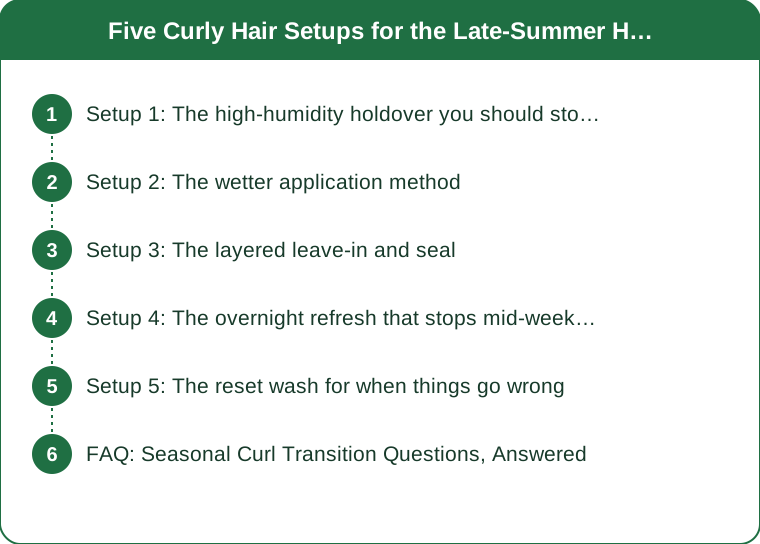
Setup 1: The high-humidity holdover you should stop using
This is the routine you have been running since June, and it is worth naming clearly before replacing it.
The July setup is built around anti-humectant strategy: minimal glycerin, a strong gel cast, a sealing layer to keep atmospheric moisture from swelling the hair shaft and lifting the cuticle. It works, because in genuinely humid air the enemy is water getting in.
When absolute humidity drops — and in late August it drops faster than the temperature does — that same setup starts working against you. The strong cast is now sealing a hair shaft that does not have enough water in it. The low-glycerin formula that protected you in July now provides nothing to draw moisture from an environment that has less of it to give.
The signs you have overstayed the summer routine:
- Curls that feel stiff and straw-like rather than springy after you scrunch out the cast
- More single-strand knots than you had a month ago
- Ends looking noticeably lighter and drier than mid-lengths
- Your usual product amount suddenly leaving white residue
What to change first: cut your gel quantity by about a third and add a leave-in step before it. That single swap resolves most of the transition period for most curl patterns.
Setup 2: The wetter application method
The most underrated variable in curl styling is not the product. It is how much water is in the hair when the product goes on.
In summer, applying to damp hair works because ambient humidity keeps topping the moisture up through the day. In drier air, damp application means the hair dries out fully within the hour and the cast sets around under-hydrated strands.
The setup: apply everything to soaking wet hair, in the shower or immediately after, before any towel contact at all.
The sequence:
- Rinse conditioner out only partially, or skip the final rinse on the ends entirely
- With hair still dripping, apply leave-in and rake through
- Add styler to hair that is still visibly wet, not damp
- Only then move to a microfibre towel or cotton t-shirt, and squeeze rather than rub
The reason this works is that most curl products are designed to trap the water already present, not to add water. A product applied to damp hair traps a damp amount of water. Applied to soaking hair, it traps considerably more, and the curl clumps form around a fuller shaft.
Expect longer drying time. That is the trade, and in cooler weather it is worth planning around — this is a setup for evenings or days you are not leaving immediately.
Setup 3: The layered leave-in and seal
This is the core autumn-transition routine, and the one most people end up settling on.
The order: water-based leave-in, then cream, then a small amount of oil, then a reduced amount of gel. Four steps sounds like a lot; in practice it takes about ninety seconds.
The water-based leave-in does the actual hydrating. Look for water as the first ingredient. This is the layer people skip in summer because humidity was doing the job for free.
The cream adds slip and softness and starts the sealing process. On finer curl patterns this can be skipped or replaced by more leave-in.
The oil is the step that changes most from summer. A small amount — genuinely small, a few drops warmed between the palms — smoothed over lengths and ends only. Its function is slowing water loss into drier air. Lighter oils sit better on fine hair; denser ones suit coarser textures.
The gel provides hold, and in autumn you want less of it than you are used to. The cast should be light enough to scrunch out completely.
The rule of thumb: as humidity falls, the ratio should shift toward the cream and oil and away from the gel. In July it might be mostly gel. By October it might be mostly cream.

Setup 4: The overnight refresh that stops mid-week decline
Curls decline faster in dry air, and the second and third day are where the transition period is most obvious.
The problem is that a standard refresh — spray water, scrunch — puts water on the hair with nothing to hold it, so it evaporates into the dry air within twenty minutes and leaves the hair worse than before.
The setup: refresh with a mix, not with plain water, and do it at night rather than in the morning.
- Fill a spray bottle with mostly water plus a small squeeze of leave-in conditioner. Shake before each use.
- Mist a section at a time, not the whole head at once.
- Cup and scrunch each section rather than raking.
- Do this in the evening, then protect the hair overnight — a satin bonnet, a satin pillowcase, or loose pineappling.
Doing it at night gives the hair several hours to absorb rather than a twenty-minute window before you walk out the door. It also means you wake up with curls already reformed instead of trying to fix them under time pressure.
On the protection layer: the switch from cotton to satin matters more in autumn than in summer, because cotton actively wicks moisture out of the hair overnight and there is less ambient moisture to replace it.
Setup 5: The reset wash for when things go wrong
Every transition produces at least one week where the hair simply stops responding. Usually this is buildup, and usually it is buildup of exactly the products that worked in July.
The setup: a clarifying wash followed immediately by a deep conditioning treatment, then straight into the Setup 3 routine on the same wash day.
The sequence:
- Clarifying or chelating shampoo, worked into the scalp thoroughly, one wash only
- A deep conditioner or mask, left on for a genuine 10 to 20 minutes rather than a rinse-through
- Optional heat — a warm towel or a shower cap and the residual heat of the bathroom improves penetration
- Rinse with cooler water than you would normally use
- Style on soaking wet hair from there
Do this roughly once a month through the transition, not weekly. Clarifying too frequently strips the hair in exactly the season it can least afford it.
The signal that you need it: products that used to absorb now sit on the surface, curls look limp at the root, and the hair feels coated even when clean.
If breakage rather than dryness is the main issue — strands snapping mid-length rather than looking dull — that is a protein and moisture balance question rather than a buildup one, and it is worth handling separately before adding more product.
FAQ: Seasonal Curl Transition Questions, Answered
How do I know when to actually switch routines?
Watch the dew point rather than the temperature or the humidity percentage. A dew point below roughly 10°C is where most curl patterns start needing the autumn setup; above about 15°C the summer anti-humectant approach is still doing its job. Most weather apps show it if you scroll.
Should I stop using glycerin products entirely?
No — the relationship reverses rather than disappearing. Glycerin pulls moisture from the air in humid conditions and can pull it out of your hair in very dry air, so it becomes less useful as autumn deepens. Through the transition it is usually fine; in genuine winter dryness, layering a sealing oil over it matters more than avoiding it.
Why are my ends suddenly so much worse than the rest?
Ends are the oldest hair and have the most cuticle damage, so they lose water fastest when ambient humidity drops. They are the first place the transition shows. Concentrating your oil step on the last few inches and getting a small trim at the change of season usually resolves it.
TL;DR:
- Late-August humidity drops faster than temperature, and the July anti-frizz routine turns into a drying routine
- Cut gel by about a third and add a water-based leave-in as the first layer
- Apply to soaking wet hair rather than damp — products trap water, they do not add it
- Refresh at night with a water-and-leave-in mix, not plain water in the morning
- Clarify roughly monthly through the transition, then deep condition on the same day
The routine that carries you into October is not a different philosophy. It is the same steps in a different ratio, shifted from keeping moisture out to keeping moisture in.
Keep Reading
This article is for general informational and styling purposes only. Fit, sizing, and product availability may vary.