5 Curly Hair Myths That Are Quietly Wrecking Your Routine
Quick Answer: Not all curly hair advice applies to all curl types — some popular rules (more product is always better, never brush curls, wash less often) actively work against certain hair textures and porosities. Here are 5 of the most common misapplied rules.
Curly hair advice spreads fast online, but curl type, porosity, and density vary enormously — a rule that transforms one person’s curls can flatten or dry out someone else’s. Here are 5 widely repeated ‘rules’ worth questioning for your specific hair.
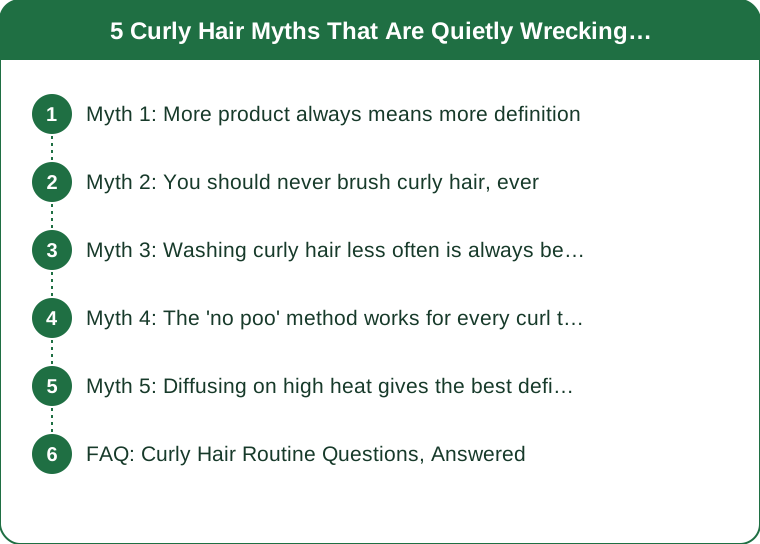
Myth 1: More product always means more definition
For high-porosity or fine curls, piling on product often causes buildup and weigh-down rather than better definition — the curl pattern gets flattened under the product’s weight instead of enhanced by it.
The fix is testing product amount specifically for your density and porosity, starting with less than instructions suggest and adding only if curls genuinely look under-moisturized, not just because a routine video used a large amount.
Myth 2: You should never brush curly hair, ever
This rule makes sense for dry curls (brushing dry curls does break the pattern and cause frizz), but it doesn’t apply universally — many curl types actually benefit from brushing in the shower with conditioner, which detangles without disrupting the wet curl pattern the way dry brushing does.
Skipping detangling entirely because ‘you’re never supposed to brush curls’ often leads to worse tangling and breakage than a proper wet detangling routine would.
Myth 3: Washing curly hair less often is always better
This depends heavily on scalp type and product buildup, not just curl pattern. An oily scalp or heavy product user who stretches washes too far often ends up with scalp buildup that actually worsens curl definition and can contribute to irritation.
The better rule is washing based on your specific scalp’s oil production and product use, which for some curly-haired people is every 2-3 days, not the once-a-week standard sometimes presented as universal.

Myth 4: The ‘no poo’ method works for every curl type
Skipping shampoo entirely (co-washing only) works well for some dry, coarse curl types but can leave fine or oily-scalp curls looking weighed down and dull from accumulated product and natural oil that conditioner alone doesn’t fully remove.
A middle ground — a gentle, sulfate-free shampoo used periodically even within a co-wash-heavy routine — often serves fine or oily curls better than strict adherence to a no-poo method borrowed from someone with different hair.
Myth 5: Diffusing on high heat gives the best definition
High heat can actually increase frizz and disrupt curl pattern for some hair types by drying the outer layer of the curl too fast, before the inner structure has set — the curl ‘sets’ better with lower, more even heat over a slightly longer time for many textures.
Starting with medium-low heat and adjusting based on your actual results, rather than assuming high heat equals faster and better, tends to produce more consistent definition.

FAQ: Curly Hair Routine Questions, Answered
How do you figure out what actually works for your specific curls?
Track changes one variable at a time (wash frequency, product amount, heat setting) for 2-3 weeks each rather than overhauling the whole routine at once, so you can tell what’s actually causing which result.
Does curl type (2A vs 4C, for example) determine which of these myths apply?
Partly, but porosity and density matter just as much as curl pattern classification — two people with the same curl type but different porosity can need opposite approaches to product amount and wash frequency.
Is it worth consulting a curl-specialist stylist to figure this out faster?
Often yes, especially if self-experimentation has stalled — a specialist can assess porosity and density directly rather than you guessing through trial and error over months.
TL;DR:
- ‘More product’ and ‘never brush’ are curl-type-dependent, not universal rules
- Wash frequency should follow scalp oil production, not a generic weekly schedule
- No-poo methods suit some textures and weigh down others
- Lower, steadier diffuser heat often defines curls better than high heat
Most curly hair frustration comes from applying someone else’s rule to a different curl type — test one variable at a time to find what your specific hair actually responds to.
Keep Reading
This article is for general informational and styling purposes only. Fit, sizing, and product availability may vary.