5 Signs Your Curl Routine Needs to Change for Fall
Quick Answer: Summer curl routines are built to fight humidity — heavy holds, anti-humectant products, strong gels. As the air dries out in fall, those same products leave curls stiff, dull, and brittle. The main swap is from humidity-blocking to moisture-adding: lighter holds, more leave-in, and humectants back in the routine.
Same products, same technique, and suddenly your curls are crunchy and frizzy at the same time.
Nothing about your hair changed. The air did — and a summer routine in autumn air produces very specific and recognizable symptoms.

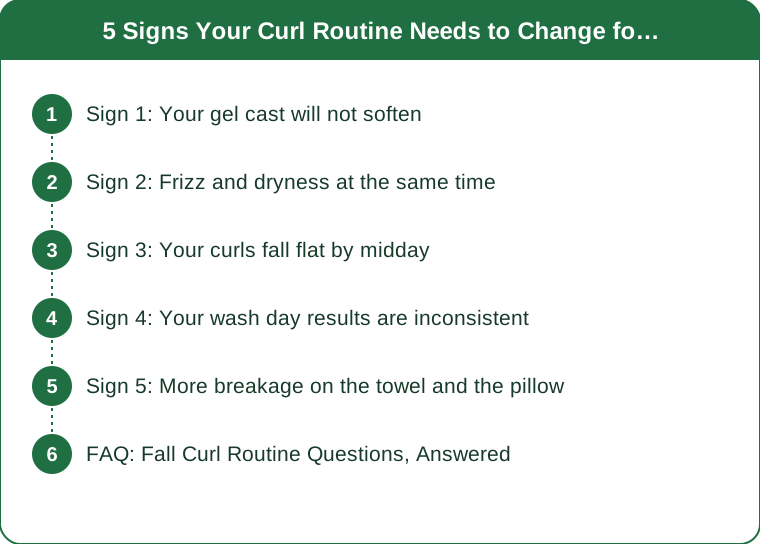
Sign 1: Your gel cast will not soften
What you are seeing: you scrunch out the crunch as usual and the cast stays stiff, or the curls fall apart into frizz when it finally breaks.
Why it happens: strong-hold gels are formulated to lock curl shape against humidity — that is the whole job in July. In drier fall air, the same polymer film sets harder and has less ambient moisture to keep the hair pliable underneath it. You get a brittle cast over dry hair rather than a flexible one over hydrated hair.
The swap: move down one hold level, and add moisture underneath rather than fighting the gel. A leave-in conditioner applied more generously before the gel gives the cast something soft to sit on. If you use a hard-hold gel, try mixing it 50/50 with a cream or a lighter gel.
Also worth trying: scrunching with a few drops of oil in your palms rather than dry hands. It breaks the cast more gently and adds the slip that drier air is stripping.
Sign 2: Frizz and dryness at the same time
What you are seeing: your hair looks frizzy in the way it did in humidity, but it also feels rough and straw-like. This combination confuses people because frizz reads as a humidity problem.
Why it happens: frizz is hair seeking moisture equilibrium, and it goes both directions. In humidity, dry hair pulls moisture in from the air and swells. In dry air, hair loses moisture out and the cuticle lifts as it dehydrates — same frizzy appearance, opposite cause.
Why summer products make it worse: anti-humectant summer formulas are designed to block moisture exchange. In dry air, blocking works against you — you are sealing hair that needs moisture added, not kept out.
The swap: bring humectants back. Glycerin, honey, aloe, and panthenol pull moisture into hair and are genuinely useful once the air dries out. The exception is very dry, low-humidity climates, where humectants can pull moisture from your hair into the air — if glycerin makes your hair worse rather than better, that is what is happening, and film-formers plus oils are the better route.
Sign 3: Your curls fall flat by midday
What you are seeing: good definition in the morning, limp and stretched-out by 2 p.m.
Why it happens: two causes, and they need different fixes.
If hair is greasy at the root, it is product buildup. Summer routines layer heavy stylers daily, and cooler weather often means less frequent washing — the buildup weighs curls down and blocks the moisture you are now adding.
If hair is dry and stretched rather than greasy, it is losing internal moisture through the day and the curl pattern loosens as it dehydrates.
The swap for buildup: a clarifying wash. Once now, then every four to six weeks through fall. This single step fixes more “my products stopped working” complaints than any product change does — most curl products are film-formers, and films accumulate.
The swap for dryness: a refresh spray with water and a little leave-in, applied midday. Not more product on top of dry hair — water first, always.

Sign 4: Your wash day results are inconsistent
What you are seeing: the exact same routine gives you great curls one day and a mess two days later, with no obvious variable changed.
Why it happens: early fall weather swings enormously — an 80°F humid day followed by a 55°F dry one. Humectant-heavy products behave completely differently in those two conditions, and a routine calibrated to one fails in the other.
The swap: stop using one fixed routine and build a two-product system. Keep your summer anti-humidity gel and your new fall moisturizing cream, and choose based on the day rather than the month. Check the humidity on your phone before wash day — above roughly 60 percent, use the summer product; below, use the fall one.
This sounds fussy and takes about five seconds. It also resolves the entire transitional-season problem, which otherwise lasts six weeks of frustration every spring and fall.
One constant regardless of the day: apply products to soaking wet hair. The single most common technique error, and it costs more definition than any product choice.
Sign 5: More breakage on the towel and the pillow
What you are seeing: more short broken pieces than usual, and more shedding at the ends specifically.
Why it happens: dry air plus indoor heating starting up plus summer accumulated damage — sun, chlorine, salt water — arriving at the same time. Fall is when the summer’s damage becomes visible, because the moisture that was masking it is gone.
The swaps, in order of impact:
- A deep conditioner weekly, not monthly. This is the highest-value change on the list, and it is the one most people postpone.
- Check your protein-moisture balance. If hair feels mushy and overly soft, it needs protein. If it feels stiff and snappy, it has too much protein and needs moisture. Fall damage usually calls for protein first, then moisture.
- Silk or satin at night, if you are not already. Cotton pillowcases pull moisture out of hair, which matters much more in dry air.
- A trim. Summer-damaged ends will keep splitting upward regardless of what you put on them, and no product repairs a split.
If breakage is sudden, severe, or accompanied by scalp symptoms or noticeable thinning, that is worth seeing a doctor or dermatologist about rather than treating as a product problem. This is general information, not medical advice.
FAQ: Fall Curl Routine Questions, Answered
When should I actually switch my routine?
Watch the humidity, not the calendar. When your local average drops below roughly 60 percent consistently, start transitioning. In most of the US that lands somewhere in September or October, and it varies a lot by region.
Do I need to replace all my products?
No. Most people need two changes: a lighter or softened hold, and more moisture underneath. Keep your summer gel for humid days — you will want it again in spring, and dry autumn days are exactly when a lighter cream serves better.
Is my hair actually changing, or just the weather?
Usually the weather. Curl pattern can genuinely shift with hormones, medication, and age, but a change that arrives with the season and reverses with it is environmental. If your pattern changed and stayed changed across seasons, that is worth a different conversation.
TL;DR: Summer curl products are built to block moisture. Fall air needs the opposite.
- A cast that will not soften means the hold is too strong for dry air — drop a level and add leave-in underneath.
- Frizzy and dry at once is moisture loss, not humidity. Bring humectants back unless you are in a very dry climate.
- Flat by midday is buildup if greasy, dehydration if dry. Clarify now, then every four to six weeks.
- Inconsistent results are the weather swinging. Keep two products and choose by the day’s humidity.
- New breakage is summer damage becoming visible. Weekly deep conditioner, check protein balance, silk at night, and trim the ends.
- Apply to soaking wet hair, always, in every season.
Check the humidity before wash day. Five seconds, and it solves most of the transitional-season mess.
Keep Reading
This article is for general informational and styling purposes only. Fit, sizing, and product availability may vary.