5 Signs Your Diffuser Is Quietly Damaging Your Curls
Quick Answer: Look for increased frizz right after drying (not before), a rough or straw-like texture when curls are dry, and curls that feel springy wet but limp once fully dry — all early signs of heat damage before visible breakage sets in.
Diffusing feels safer than a flat iron, and it mostly is — but ‘safer’ isn’t the same as ‘safe,’ and a lot of curly hair damage builds up slowly enough that people miss the early signals.

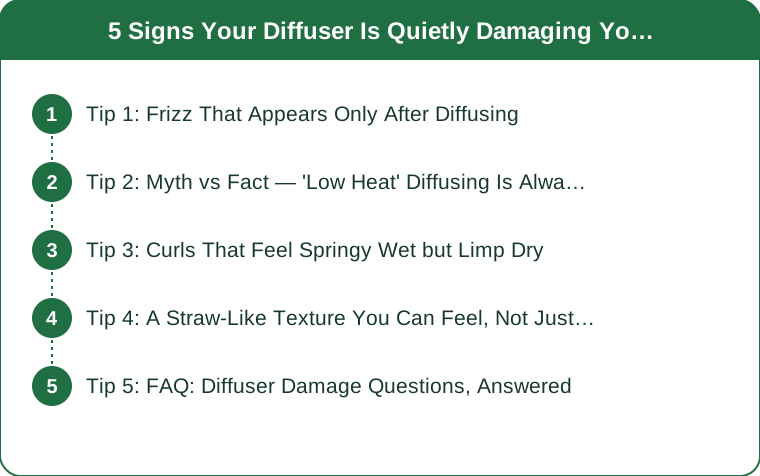
Tip 1: Frizz That Appears Only After Diffusing
If your curls look defined coming out of the shower but frizz up specifically during or right after diffusing — not from humidity, not from touching them — that’s often heat lifting the hair cuticle. Compare a diffused section to one you let air-dry; a noticeable difference in frizz between the two is a useful diagnostic most people never actually do.
Tip 2: Myth vs Fact — ‘Low Heat’ Diffusing Is Always Safe
Myth: as long as you’re not on high heat, diffusing can’t damage curls. Fact: duration matters as much as temperature — 20 minutes on low can deliver more cumulative heat exposure than 8 minutes on medium. Total heat exposure time is the more useful thing to track than the dial setting alone.

Tip 3: Curls That Feel Springy Wet but Limp Dry
Healthy curls hold their shape reasonably well from wet to dry, with some natural loosening. If your curl pattern looks great right out of the shower but falls noticeably flatter once fully dry — especially compared to how it used to behave — that’s often a sign the hair shaft’s protein structure is compromised, reducing its ability to hold curl shape once moisture leaves.
Tip 4: A Straw-Like Texture You Can Feel, Not Just See
Run a dry section between your fingers. Healthy curly hair should feel somewhat smooth despite its texture; damaged hair often feels rough, dry, or brittle even right after a wash day, regardless of how much product you’ve used. Product buildup can mimic dryness, so this check works best on freshly clarified hair, not hair with three days of styling product on it.

Tip 5: FAQ: Diffuser Damage Questions, Answered
How often should I actually be diffusing?
Most curl specialists suggest limiting high heat styling to 2-3 times a week if you’re noticing early damage signs, giving hair recovery time between sessions.
Does a heat protectant actually prevent this?
A good heat protectant reduces damage but doesn’t eliminate it — it’s a mitigation tool, not a shield that lets you diffuse without limits.
Can heat damage be reversed, or do I have to cut it out?
Heat damage to the protein structure isn’t reversible with products — deep conditioning treatments improve how it feels and behaves, but the underlying damage grows out rather than heals.
TL;DR:
- Frizz that appears only after diffusing, not before, is an early red flag
- Duration matters as much as heat setting — total exposure time is the real variable
- Springy-wet-but-limp-dry curls signal protein structure damage
- A straw-like texture on clarified hair is a reliable physical check
Catching these signs early means you can adjust your routine before you’re dealing with actual breakage — worth a quick check on your next wash day.
Keep Reading
This article is for general informational and styling purposes only. Fit, sizing, and product availability may vary.