5 Curl Routines for the First Week of Cooler Air
Quick Answer: When humidity drops, humectants stop pulling moisture from the air and start pulling it out of your hair. That is why glycerin-heavy summer products suddenly cause frizz and straw texture in autumn. The fix is a routine shift, not a product panic: more leave-in and sealing oil, less gel-only styling, and a deep conditioner every 7-10 days instead of monthly. Below are five routines for the specific problems that show up in the transition week.
The first genuinely cool morning is a shock to a curl routine. Same products, same technique, completely different result - flatter at the root, frizzier at the ends, and a cast that cracks instead of scrunching out. Here are five routines mapped to five specific things that go wrong.

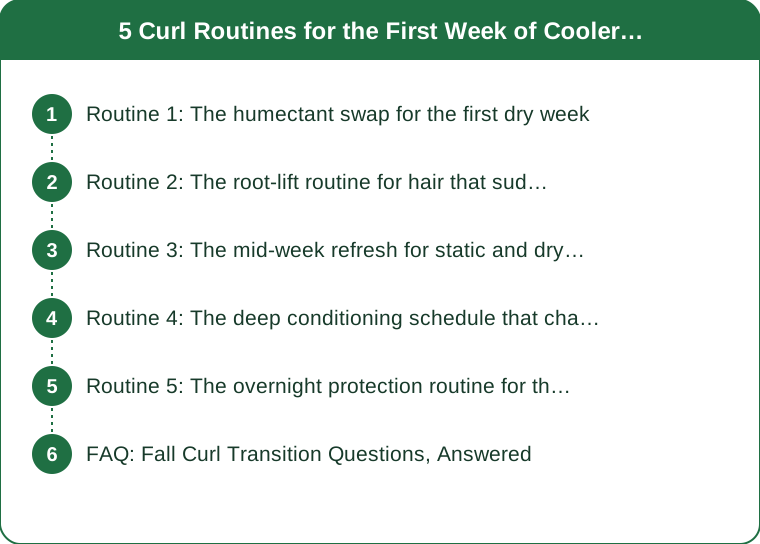
Routine 1: The humectant swap for the first dry week
This is the one to run the moment the air changes, because it fixes the largest number of complaints at once.
What is happening: glycerin, honey, and similar humectants are moisture magnets. In 70% humidity they pull water from the air into your hair, which is exactly what you want. Below roughly 40% humidity, the gradient reverses - they start pulling moisture out of the hair shaft and into the dry air, leaving curls brittle and frizzy at the same time.
The routine: wash as normal, then apply a cream-based leave-in on soaking wet hair before any gel. Rake it through in sections, then scrunch. Follow with a light oil - jojoba, argan, or grapeseed - on the mid-lengths and ends only. Then gel over the top, applied by praying-hands rather than raking so you do not disturb the clumps.
The order matters more than the products. The cream provides the moisture, the oil seals it in, and the gel becomes a shell rather than the moisture source it accidentally was all summer.
What to look for on labels: move glycerin down the ingredient list, or switch to a leave-in where it appears after the fifth or sixth ingredient. You do not need to eliminate it - just stop letting it lead.
Routine 2: The root-lift routine for hair that suddenly sits flat
Cooler air brings hats, hoods, and higher-collar layers, and all three flatten the crown before you have left the house.
The routine: clip while drying. After styling, place three to five duckbill clips at the root on the top and sides, lifting each section straight up from the scalp before clipping. Leave them in for the entire drying time, whether that is air drying or diffusing.
If diffusing, work root first, upside down, on low speed and medium heat for the first five minutes, then flip and finish the lengths. High speed is what creates frizz - the airflow disrupts curl clumps before the cast sets.
For hat days specifically: put the hat on only when hair is fully dry, and choose a satin-lined beanie. A cotton or wool interior does two damaging things - it creates friction frizz, and it absorbs the moisture you just spent twenty minutes putting in.
A fix for when it has already happened: do not re-wet the whole head. Mist water at the roots only, massage lightly at the scalp with fingertips, and diffuse for two minutes upside down. The curl pattern lower down stays intact.
Routine 3: The mid-week refresh for static and dry air
Static is a specifically autumn problem and it is not a hair health issue - it is dry indoor air plus friction from wool and synthetic layers.
The routine: in a spray bottle, combine water with a small amount of leave-in conditioner - roughly a teaspoon per cup, enough that it looks faintly cloudy. Mist over the whole head lightly, not to saturation. Then cup sections in your palms and scrunch upward. Do not comb, do not rake, do not touch it again while drying.
For immediate static in the middle of the day: run a tiny amount of oil across your palms, rub them together until they look almost dry, and smooth over the surface only. Half the amount you think you need is usually right.
The bigger lever is environmental. A humidifier in the bedroom running overnight at 40-50% humidity improves next-morning hair more than any refresh product, and it helps skin and sinuses at the same time. This is the single highest-return purchase for curly hair in a cold climate.
Also worth checking: heated car seats and vents blowing directly at your head both dry hair aggressively on a commute. Redirect the vents.

Routine 4: The deep conditioning schedule that changes with the season
Most people deep condition on a fixed schedule regardless of season. That is a mistake in both directions - too often in summer, nowhere near often enough in autumn and winter.
The routine: move to a deep conditioner every 7-10 days from the first cool week onward. Apply to clean, damp hair, section it properly rather than piling it on top, and add heat - a shower cap for 20 minutes, a warm towel, or a hooded dryer. Heat opens the cuticle enough for the conditioner to work rather than sitting on the surface.
Balance protein and moisture. If curls feel mushy, limp, and refuse to hold definition, that is a protein need. If they feel stiff, crunchy, and snap rather than stretch, that is protein overload and you need moisture only. Most people in autumn need moisture-heavy with protein monthly, but check by stretching a wet strand: it should stretch a little and spring back. No stretch means protein overload; endless stretch with no return means it needs protein.
One efficiency note: deep conditioning works better on hair that has been clarified recently. If you have been layering gels and oils all summer, a clarifying wash before your first autumn deep conditioner makes a visible difference - product buildup blocks everything you apply after it.
Routine 5: The overnight protection routine for the layering season
More layers, more friction, more hats, and drier air all mean overnight protection matters more from September onward than it did in July.
The routine: the pineapple for looser curls - gather loosely at the very top of the head with a satin scrunchie, no tension at the roots. For tighter curls or shorter lengths, two to four loose plaits protect better and give a soft wave in the morning that scrunches out easily.
Then a satin or silk pillowcase, non-negotiable in dry months. Cotton absorbs moisture directly out of hair overnight and creates friction frizz across the entire back of the head. A satin bonnet works even better if you will actually keep it on.
Morning: do not brush, do not rake, do not fully re-wet. Take the pineapple down, flip the head forward, shake at the roots, and mist only where it is genuinely flat. Two minutes total.
The compounding effect is the point. Overnight friction damage is invisible day to day and obvious across a season. The people whose curls look better in February than October are almost always the ones who protected them every single night, not the ones who found a better product.
FAQ: Fall Curl Transition Questions, Answered
How fast should I switch products when the weather changes?
Switch one thing at a time, starting with the leave-in, and give it two wash days before judging. Changing your whole routine at once means you learn nothing about what actually helped.
Do I need completely different products for winter?
Usually not different products - different proportions. More leave-in, more sealing oil, less gel, more frequent deep conditioning. Most people already own everything they need and are just using it in summer ratios.
Why is my hair frizzy and greasy at the same time?
That combination almost always means product buildup at the root with dryness at the ends. Clarify once, then restart with product applied from the ears down and nothing heavy at the scalp.
Is it normal to shed more in the fall?
Some seasonal shedding variation is commonly reported and typically resolves within a couple of months. If shedding is dramatic, patchy, or paired with scalp symptoms, see a professional rather than adjusting your conditioner. This is general information, not medical advice.
TL;DR:
- Dry air flips humectants from helpful to harmful - lead with cream leave-in, seal with oil, finish with gel.
- Clip the roots while drying and only wear hats on fully dry hair, satin-lined.
- Refresh with water plus a little leave-in, and run a humidifier at 40-50%.
- Deep condition every 7-10 days with heat, and protect every single night on satin.
The transition week is genuinely disorienting, but it is short. Make these five adjustments in the first fortnight of cool air and the rest of the season is just maintenance.
Keep Reading
This article is for general informational and styling purposes only. Fit, sizing, and product availability may vary.