5 End-of-Summer Curl Recovery Steps That Actually Repair the Damage
Quick Answer: Work in order: clarify first, then assess whether the problem is protein or moisture, then rebuild, then protect, then reset your routine for the new season. Clarifying first matters because product buildup and mineral deposits from pool and beach water make every other treatment sit on the surface instead of penetrating.
Most end-of-summer curl routines fail because they start with a deep conditioner on hair that cannot absorb anything.
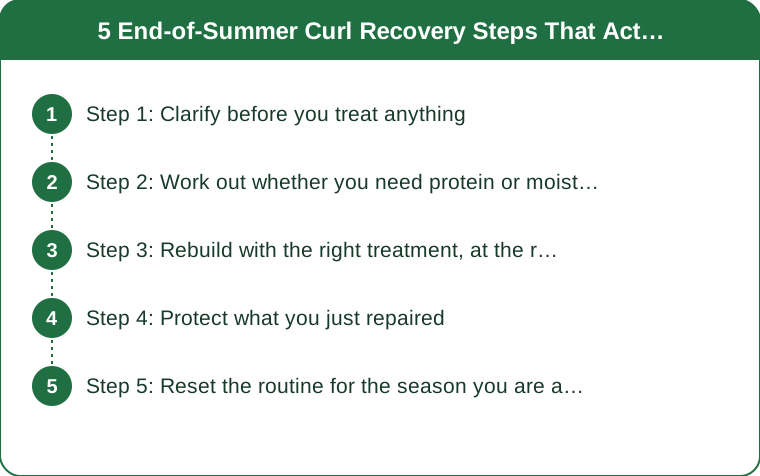
Step 1: Clarify before you treat anything
Everything else in this list depends on this one, and it is the step people skip.
What accumulates over a summer:
- Product buildup from heavier gels, creams, and the extra layers humidity demanded
- Mineral deposits from pool water, hard water, and sea water. Copper, calcium and magnesium bind to the hair shaft and are not removed by ordinary co-washing
- Sunscreen residue, which is genuinely difficult to remove and frequently overlooked
- Silicone layers if any of your summer products contained non-water-soluble silicones
Why it blocks recovery. Treatments work by penetrating the cuticle. A coated shaft repels them. This is why a deep conditioner that transformed your hair in April does nothing in September - the product is sitting on a mineral and silicone layer and rinsing straight off.
How to do it properly:
- Use a clarifying shampoo, or a chelating shampoo specifically if you swam regularly. Chelating formulas bind minerals; ordinary clarifying shampoos mostly remove product and the distinction matters after a pool summer
- Apply to the scalp and let the suds travel down the lengths rather than scrubbing the ends
- Expect it to feel stripped afterward. That is the point, and it is why the next step follows immediately
- Once is usually enough. Twice if the hair still feels coated
The tell that you needed it: hair that suddenly responds to product again, and curls that clump in the shower in a way they had stopped doing.
Step 2: Work out whether you need protein or moisture
These produce similar-looking hair and require opposite treatments, and guessing wrong makes things worse.
The strand test. Take a shed strand, wet it, and stretch it gently.
- Stretches a long way and does not spring back, feels mushy: you need protein. The internal structure is compromised
- Barely stretches, snaps quickly, feels stiff and rough: you need moisture. The hair is dry and brittle
- Stretches somewhat and returns: balanced, and you should focus on protecting rather than treating
What a summer typically does. Sun and chlorine degrade the protein structure, while sun, heat and salt strip moisture. Most people finish a summer needing both, which is why the sequence matters: protein first to restore structure, moisture after to restore flexibility.
Signs pointing to protein loss specifically:
- Curls that have loosened or dropped and will not re-form
- Gummy, stretchy texture when wet
- Hair that absorbs product endlessly and still feels limp
Signs pointing to moisture loss specifically:
- Rough, straw-like feel and audible crunch
- Breakage on brushing rather than stretching
- Frizz that appears immediately after drying rather than through the day
The common error - protein overload. Applying protein treatment weekly to hair that needed moisture produces brittle, stiff, snapping hair within about three weeks. If your hair got worse after you started a repair routine, this is the most likely reason. The fix is to stop the protein and use a rich, protein-free conditioner for two to three weeks.

Step 3: Rebuild with the right treatment, at the right frequency
Frequency matters more than product cost here.
If protein is the answer:
- Use a protein or bond-building treatment once, then wait a full week and reassess. Do not schedule a series in advance
- Follow every protein treatment with a moisturizing conditioner in the same session. Protein without moisture after it is the single fastest route to brittleness
- Most damaged hair needs 2 to 4 treatments spaced a week apart, not weekly forever
If moisture is the answer:
- Deep condition weekly for three to four weeks, then drop back to every other week
- Heat helps meaningfully - a shower cap for 20 minutes, or wrapping in a warm towel. Warmth lifts the cuticle and improves penetration
- Apply to damp rather than soaking hair. Water already in the shaft leaves less room for the treatment
For both, three things that quietly matter:
- Detangle only with conditioner in and only with fingers or a wide-tooth comb. Post-summer hair is at its most fragile and this is where most breakage happens
- Rinse cooler than feels nice. Very hot water raises the cuticle and undoes some of what you just did
- Do not add every product at once. Adding four new things means learning nothing about which helped
A realistic timeline. Structural improvement is visible in 2 to 3 weeks. Curl pattern recovery, where it recovers at all, takes 6 to 8 weeks - and genuinely heat-damaged or chemically damaged sections do not come back. They grow out. Knowing which category you are in prevents months of treating hair that needs cutting.
Step 4: Protect what you just repaired
Recovery without changed habits means repeating this in six months.
Overnight protection, which does the most for the least effort:
- A satin or silk pillowcase, or a bonnet. Cotton absorbs moisture from hair and creates friction. This single change reduces morning frizz and mechanical damage noticeably
- Pineapple or loose braid to keep curls off the pillow entirely
- Do not sleep on soaking hair. Wet hair is at its weakest and friction damage is highest
Water protection, if swimming continues into fall:
- Wet hair with clean water before entering a pool. Saturated hair absorbs far less chlorinated water
- A leave-in conditioner or oil as a barrier layer before swimming
- Rinse immediately after, not when you get home
Heat protection, which becomes more relevant as diffusing season returns:
- Diffuse on medium heat rather than high. The time saved on high is not worth the cuticle cost
- Always use a heat protectant if using any direct heat
- Let hair air dry to roughly 60 percent before diffusing, which cuts total heat exposure substantially
Mechanical protection:
- Microfiber towel or cotton t-shirt, never a terry towel
- Scrunch, never rub
- Snag-free hair ties, and never the same tie position two days running
The overlooked one: your water. Hard water deposits minerals continuously, which is why some people need chelating treatment monthly rather than seasonally. A shower filter is a genuine fix for this and costs less than the treatments it replaces.
Step 5: Reset the routine for the season you are actually in
The products that worked in August are wrong for October, and keeping them is why curls feel worse as the weather improves.
What changes as humidity drops:
- Anti-humidity products stop being useful and start weighing hair down. The strong-hold gels that fought frizz in July are excessive in dry air
- Static appears, which is a dryness problem rather than a frizz problem and needs moisture, not hold
- Hair dries faster in dry air, meaning less time for products to set and more risk of the cast forming before the curl clumps
The specific swaps worth making:
- Lighter hold, more moisture. Move from a firm gel to a softer gel or a cream-gel combination
- Add a leave-in if you did not use one. Summer humidity supplied ambient moisture; fall air removes it
- Reduce clarifying frequency once the summer buildup is gone, to roughly monthly
- Consider a heavier sealing step at the ends, which are the oldest and most damaged hair and suffer first in dry air
Adjusting technique, not just product:
- Apply product to wetter hair than you did in summer, since evaporation is faster
- Scrunch out the crunch only once fully dry - doing it early in dry air causes frizz that humidity would have forgiven
- Refresh with water plus a little leave-in rather than water alone, which in dry air can dry out hair further
How to know the reset worked. Give any routine change three wash days before judging. The first wash after a change is almost always unrepresentative because residual product from the old routine is still present, and people abandon good changes on the evidence of a single bad day.
TL;DR:
- Clarify or chelate first - treatments cannot penetrate through mineral and product buildup
- Do the wet strand stretch test to find out whether you need protein or moisture; they look alike and need opposite fixes
- Protein treatments go once then reassess, always followed by moisture; deep conditioning goes weekly for three to four weeks
- Protect with satin, cooler rinses, gentler drying, and a shower filter if your water is hard
- Swap summer anti-humidity hold for lighter hold plus more moisture as the air dries out
Structural improvement shows in two to three weeks. Curl pattern takes six to eight, and truly damaged sections grow out rather than recover.
Keep Reading
This article is for general informational and styling purposes only. Fit, sizing, and product availability may vary.