Five Post-Workout Curl Fixes for the Weeks When the Air Changes
Quick Answer: As humidity falls in late summer, curls that were previously over-hydrated start losing moisture faster than your summer routine replaces it. The fix is not more product - it is shifting the balance toward leave-in moisture and sealing, reducing the heavy anti-humidity gels you needed in August, and changing how you dry after a workout. Five specific situations, five specific fixes below.
Your curls behaved all summer with a routine you had finally dialled in.
Then the air dried out by ten percent and everything is frizzy in a completely different way. Same hair, different problem, and the summer fix makes it worse.

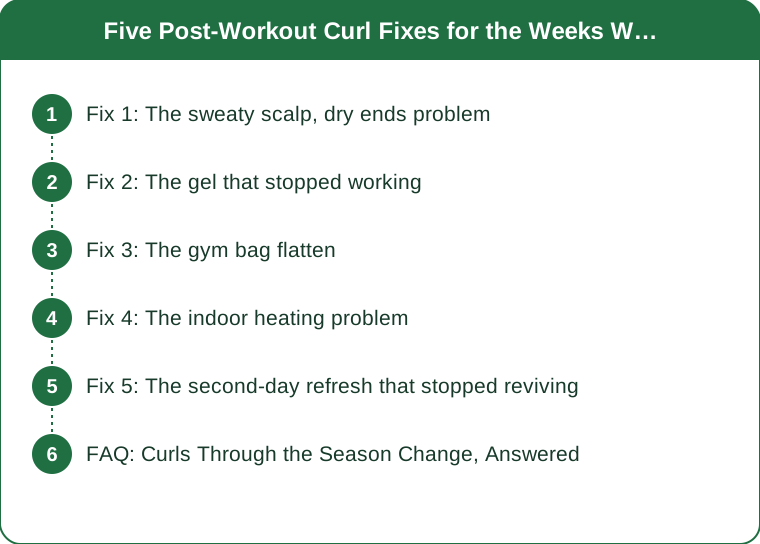
Fix 1: The sweaty scalp, dry ends problem
The situation: you finish a workout with a damp scalp and roots, while your lengths and ends are drier than they were in July.
Why it happens. Scalp sweat is not moisturising to hair - it deposits salt, which is drying as it evaporates. Meanwhile the surrounding air is pulling moisture out of your lengths faster than it did in humid conditions. You end up with two opposite problems on the same head.
What most people do wrong: treating the whole head the same way. Either washing everything, which strips already-dry ends, or refreshing everything, which weighs down a scalp that is already damp.
The fix: treat the zones separately.
- Scalp and roots: rinse with water only, or use a co-wash on roots alone. Salt needs removing; the ends do not need washing.
- Mid-lengths and ends: apply a light leave-in to damp hair, and scrunch rather than comb
- Dry the roots first with a microfibre towel or diffuser on low, leaving the lengths damper for longer
Why this works. You are removing the thing that is drying your roots while adding moisture where it is being lost. Doing one routine for both zones necessarily gets one of them wrong.
Frequency note: rinsing roots after every workout is generally fine even for curl types that do not tolerate frequent shampooing, because water alone does not strip. It is the detergent frequency that matters.
Fix 2: The gel that stopped working
The situation: the strong-hold gel that kept frizz down in August now leaves your hair crunchy, dull, and somehow still frizzy.
Why it happens. High-hold anti-humidity gels work by forming a firm cast that resists moisture from the air entering the hair shaft. In humid conditions, that is exactly what you want. In dry conditions, the same barrier is holding moisture out when you need it in, and the cast becomes brittle rather than flexible.
The fix: shift the product balance rather than the product amount.
- Reduce the gel by roughly a third and add a cream or leave-in underneath it
- Scrunch the cast out more thoroughly once fully dry - in dry air, a partially broken cast reads as frizz
- Consider a lighter-hold gel rather than eliminating hold entirely
The layering order matters. Leave-in first on soaking wet hair, cream second, gel last - this is the sequence that puts moisture inside the barrier rather than outside it. A common autumn mistake is applying gel to hair that is not wet enough, which produces uneven distribution and a patchy cast.
One counterintuitive point: frizz in dry conditions and frizz in humid conditions have opposite causes. Humid frizz is moisture entering the shaft and swelling it. Dry frizz is moisture leaving and the cuticle lifting. The same product cannot address both, which is why the routine has to change seasonally rather than just getting more of what worked.
Fix 3: The gym bag flatten
The situation: your curls survive the workout and get destroyed by the twenty minutes afterward - flat at the crown, compressed where the hair tie sat.
Why it happens. Wet or damp hair holds whatever shape it dries in. A hair tie during a workout, followed by a period of drying, sets that compression permanently until the next wet.
The fix: change what happens during the workout, not after.
- Use a claw clip or a loose top-knot secured with a spiral tie rather than a standard elastic
- Position it higher than feels natural - the crown is where flattening shows most, and a high placement keeps roots lifted
- Never leave hair in a low ponytail through a workout if you plan to wear it down after
After the workout:
- Release the hair while it is still damp, not after it has dried in place
- Root-clip the crown with small clips for the first ten minutes of air drying to restore lift
- Do not touch it once it starts drying - manipulation during the drying phase is the main frizz source
The single most effective change is the spiral or coil tie, because it distributes tension over a wider area rather than creating a hard crease at one point.
If you shower at the gym, the flattening problem is replaced by a different one: applying product and then walking outside into cool air with wet hair, which sets slowly and unevenly. A microfibre wrap for the journey home, removed at home for the final dry, gives more consistent results.

Fix 4: The indoor heating problem
The situation: curls look fine outside and go frizzy and static indoors, particularly in the evening.
Why it happens. Heated indoor air is significantly drier than outdoor autumn air. Hair loses moisture to the surrounding air, the cuticle lifts, and static builds. Most people spend the majority of their day in that environment, so it is the dominant condition even though it feels secondary.
The fix: seal and add humidity.
- Add a light oil or serum to the ends after your usual routine - this is the sealing step most summer routines skip because it was unnecessary
- Consider a humidifier in the room where you sleep, which is eight hours of exposure
- Switch to a satin or silk pillowcase if you have not - friction damage compounds with dryness
On oils specifically: the sealing step works only over hydrated hair. Oil applied to dry hair seals in the dryness. The order is water-based product first, oil last, always.
On static: it is a symptom of dryness rather than a separate problem. A satin pillowcase, a sealing step, and slightly higher indoor humidity address the cause. Anti-static sprays address the symptom for an hour.
A note on protein: many people reach for protein treatments when hair misbehaves in autumn, and that can make it worse. Dry-air frizz is usually a moisture deficit, not a protein deficit. Adding protein to moisture-starved hair makes it stiffer and more brittle. If in doubt, add moisture first and see whether it resolves.
Fix 5: The second-day refresh that stopped reviving
The situation: the water-and-leave-in refresh that revived day-two curls all summer now leaves them limp and undefined.
Why it happens. In humid conditions, a light water mist is enough because the air is helping. In dry air, the mist evaporates before it has fully rehydrated the hair, so the curl pattern relaxes without re-forming.
The fix: wetter and faster.
- Use more water, applied more directly - a spray bottle held close, or briefly running sections under the tap
- Apply the refresh product immediately while hair is genuinely wet, not misted
- Scrunch firmly enough to hear it - the sound means enough water is present for the curl to re-form
Section-based refresh works better in autumn than all-over misting. Focus on the sections that have actually lost definition - usually the crown and the face-framing pieces - and leave the rest alone.
The alternative approach: refresh at night rather than in the morning. Dampen, apply product, and sleep in a loose pineapple or a satin bonnet. The overnight period gives the moisture time to absorb rather than evaporate in the first ten minutes.
When refreshing stops working entirely, it is usually a sign that the wash-day routine needs adjusting rather than the refresh. A refresh can restore a curl pattern; it cannot compensate for hair that is genuinely under-moisturised at the source.
FAQ: Curls Through the Season Change, Answered
Do I need completely different products for autumn?
Usually not - the balance changes more than the products. Less high-hold gel, more leave-in and cream, and adding a sealing oil that summer did not need. Buying an entirely new lineup is rarely necessary.
Should I wash my hair more or less often now?
Washing frequency is more about scalp and workout salt than season. What often helps is separating the two: rinsing roots after workouts with water only, and shampooing on your existing schedule.
Why is my hair static in autumn but never in summer?
Static is a dryness effect - dry air, dry hair, friction. Humid summer air keeps the cuticle sealed and the charge dissipated. A sealing step, a satin pillowcase and some indoor humidity address the cause rather than the symptom.
Is protein or moisture the answer when curls misbehave in autumn?
Moisture first, almost always. Dry-air frizz is a moisture deficit, and adding protein on top of that makes hair stiffer and more prone to breakage. If moisture does not resolve it over a couple of weeks, then consider protein.
Can I still air dry when it gets cold?
You can, though it takes considerably longer and leaving the house with wet hair in cold air produces uneven results. A diffuser on low heat and low speed until roughly 80% dry, then air drying the rest, is a reasonable compromise that preserves definition.
TL;DR:
- Dry-air frizz and humid frizz have opposite causes, so the same routine cannot address both
- Treat scalp and ends separately after workouts: rinse roots, moisturise lengths
- Cut the high-hold gel by a third and add cream underneath - the summer cast holds moisture out
- Use a spiral tie or claw clip during workouts and release while still damp
- Add a sealing oil over hydrated hair, and consider a humidifier for the eight hours you sleep
- Refresh with genuinely wet hair, not a mist - evaporation beats absorption in dry air
The routine did not stop working. The air changed, and the product that was solving August’s problem is now causing October’s.
Keep Reading
This article is for general informational and styling purposes only. Fit, sizing, and product availability may vary.