Five Post-Workout Curl Routines for the Most Humid Weeks of the Year
Quick Answer: You do not need to wash after every sweaty session. Rinse the roots with water only, re-wet the mid-lengths, and re-cast the curl with a small amount of leave-in and gel. In high humidity, a gel with a firm hold cast beats a cream every time, because the cast is what keeps moisture in the air from expanding the cuticle. Five routines below run from 3 minutes to 20.
Sweat is mostly water and salt, and salt is drying. That is the whole reason post-workout curls feel crunchy in the wrong way - not because you needed a shampoo.

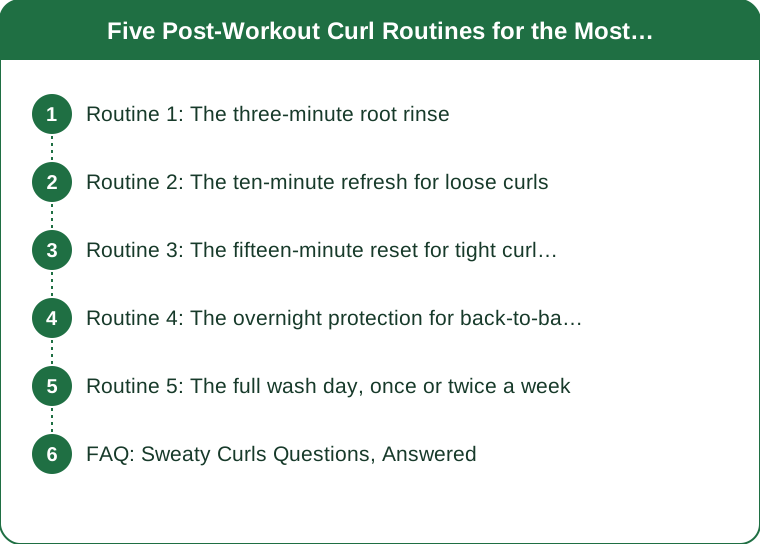
Routine 1: The three-minute root rinse
For sessions where you sweated at the scalp but the lengths are fine, which is most of them. Lean over the sink or turn your back to the shower stream and let water run over the roots only for 30 to 45 seconds. No product, no scrubbing.
Squeeze - do not rub - with a microfiber towel or cotton t-shirt, then let it air dry. Salt is water soluble, so plain water genuinely does the job of removing it.
Why it works: the curl clumps in the mid-lengths and ends stay undisturbed, which means you keep yesterday’s definition instead of rebuilding it. This is the routine for four out of five workouts.
If the roots feel greasy rather than salty, add a co-wash at the scalp only once or twice a week.
Routine 2: The ten-minute refresh for loose curls
For 2b to 3a patterns, which lose definition quickly in humidity but also re-form easily.
Mist the mid-lengths and ends with water until they are damp rather than soaked. Emulsify a dime-sized amount of leave-in between your palms and scrunch upward, section by section. Follow with a pea-sized amount of a light gel and scrunch again.
Air dry or diffuse on low heat and low speed. When fully dry, scrunch out the cast with a drop of oil on your palms.
The humidity adjustment: looser patterns are the most vulnerable to swelling in damp air, so the gel step is not optional in August even though you can skip it in March.
Routine 3: The fifteen-minute reset for tight curls and coils
For 3c to 4c patterns, where the priority is moisture retention rather than definition rescue.
Saturate hair section by section with a spray bottle - tighter patterns need genuinely wet hair, not damp. Apply a leave-in conditioner generously, then a cream, then a gel or custard on top. This is the classic layering order: thinnest to thickest.
Work in four to six sections and rake through each one before scrunching or shingling.
Why the order matters: each layer seals the one beneath it. Reversing it means the gel sits on dry hair and the moisture never gets in, which is the most common cause of a refresh that leaves hair feeling stiff and dry at once.

Routine 4: The overnight protection for back-to-back training days
If you train two days in a row, the second day is much easier when day one ends well.
Before bed, gather hair loosely into a high pineapple with a satin scrunchie, or braid in two loose sections if the pineapple flattens your crown. Sleep on a satin pillowcase or wrap with a satin scarf.
In the morning, take it down, mist lightly at the crown only, and shake out at the roots with your fingertips rather than a brush.
The gain is real: friction against cotton is what creates most of the overnight frizz people blame on humidity. Satin removes it almost entirely, which means day two needs a three-minute rinse instead of a fifteen-minute reset.
Routine 5: The full wash day, once or twice a week
Salt, sweat, product and sunscreen do accumulate, and the answer to buildup is a real wash rather than more product on top.
Use a gentle clarifying shampoo at the scalp once a week during heavy sweating months, or once every two weeks if your scalp runs dry. Follow with a conditioner, detangle in the shower while conditioner is in, and rinse with cool water to help the cuticle lay flat.
Style on soaking wet hair with the layering order from Routine 3.
A humidity note: deep conditioning helps, but over-conditioning without protein can leave curls limp in damp weather. If your curls feel stretchy and undefined despite good moisture, a protein treatment every 4 to 6 weeks is usually the missing piece.
FAQ: Sweaty Curls Questions, Answered
Do I have to wash my hair every time I work out?
No - plain water at the roots removes salt, and washing daily strips the oils curly hair depends on. Most people do well with one or two full washes a week even during heavy training.
Why does my refresh work in winter but not in August?
Humid air swells the hair shaft and undoes definition unless there is a gel cast holding the curl shape. Adding a firm-hold gel step is usually the entire fix.
Is the crunchy cast supposed to stay?
No - scrunch it out with a little oil once hair is completely dry. Scrunching while it is still damp is what creates frizz.
TL;DR:
- Sweat is mostly water and salt, so a plain water root rinse handles most workouts without a wash.
- In humidity, a firm-hold gel cast is the load-bearing step - creams alone will not hold definition.
- Layer thinnest to thickest: leave-in, cream, then gel.
- Satin at night removes most of what people blame on humidity, and makes day two a three-minute job.
The goal through the humid weeks is not to fight the weather but to spend your effort where it pays - a fast rinse most days, one real reset a week, and a cast that holds until you decide to break it.
Keep Reading
This article is for general informational and styling purposes only. Fit, sizing, and product availability may vary.