Five Wash Day Schedules That Match Different Curl Types
Quick Answer: There is no universal wash frequency for curly hair. Fine wavy hair often needs washing every two to three days because it gets weighed down fast, while tight coils commonly do best on a seven to ten day cycle. The variable that decides it is not curl tightness alone — it is scalp oil production combined with how much product your pattern needs to hold definition.
Every curly hair guide eventually says the same unhelpful thing: wash when your hair needs it. Which is fine advice if you already know what that feels like, and useless if you do not.
So here are five actual schedules, each built around a different combination of curl pattern, scalp behaviour and product load — with what the in-between days look like, because that is where wash day schedules actually succeed or fail.

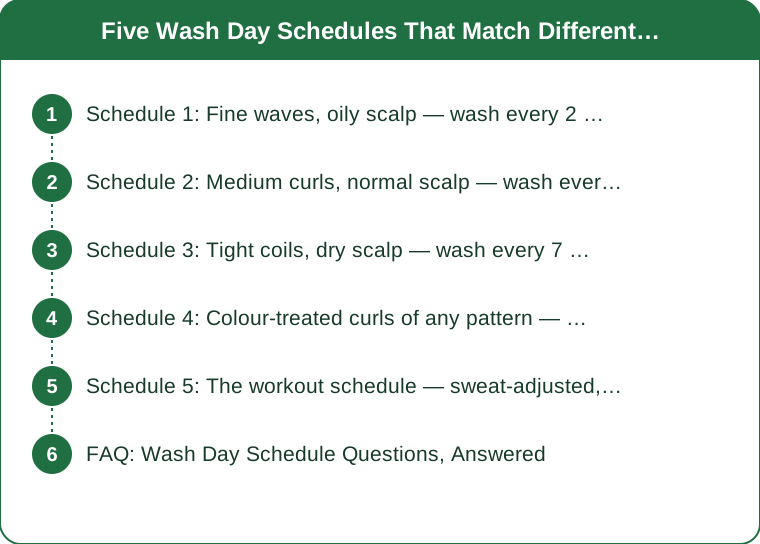
Schedule 1: Fine waves, oily scalp — wash every 2 to 3 days
This is the hardest pattern to schedule because the two halves of your head disagree. The scalp produces oil quickly and fine strands have no weight to spare, so waves collapse into limp ropes by day two. Meanwhile the mid-lengths are dry.
The rhythm: Wash day is a full cleanse with a gentle sulfate-free shampoo, focused on the scalp only. Conditioner from the ears down, never above. Styling product should be the lightest thing you own — a mousse or a foam, not a cream. Roughly a golf ball of mousse, no more.
Day 1: Best definition. Do nothing.
Day 2: Roots start going flat. Dry shampoo at the roots only, then scrunch the lengths with damp hands to reactivate the cast. This buys you the day.
Day 3: Usually the ceiling. If the roots are greasy and the ends are frizzy at the same time, you have hit it — wash.
The mistake this group makes: using rich curly-hair products designed for coarser patterns. Fine waves need the least product of any curl type and get told to use the most. If your hair looks better after a day at the beach than after your routine, you are over-conditioning.
Schedule 2: Medium curls, normal scalp — wash every 4 to 5 days
The most common pattern and the most forgiving schedule. Enough curl to hold a shape, enough scalp balance that you are not fighting oil.
The rhythm: Wash day includes a scalp massage during shampoo — genuinely two minutes, not the ten seconds most people do — followed by conditioner and a leave-in. Style with a cream plus a gel on top. The cream gives moisture, the gel gives the cast.
Day 1: Cast is hard. Scrunch it out once it is fully dry, not before.
Day 2: Peak day for most people in this group. Curls have softened but definition holds.
Day 3: Sleep disruption starts showing. Refresh with water in a spray bottle plus a pea of leave-in, focused on the crown and the sides where the pillow flattened them.
Day 4 to 5: Roots need dry shampoo, ends need moisture. A second refresh usually gets you to wash day.
The mistake this group makes: refreshing too wet. Soaking the hair on day 3 essentially restarts the drying process without the styling products to control it, and the result is frizz. Damp, not wet.
Schedule 3: Tight coils, dry scalp — wash every 7 to 10 days
Coils are structurally the driest pattern because natural scalp oil cannot travel down a tightly coiled strand. Frequent washing strips what little makes it down.
The rhythm: Wash day is a long session and worth blocking out an hour for. Pre-poo with oil for 20 to 30 minutes, cleanse with a very gentle or co-wash product, deep condition with heat for 20 minutes, then style in sections while soaking wet.
Days 1 to 3: Definition holds well if the style was set in sections.
Days 4 to 6: This is where a protective style earns its place. Twists, braids or a loose bun preserve the wash day work rather than fighting to maintain loose definition.
Days 7 to 10: Scalp starts asking for attention. A diluted apple cider vinegar rinse or a scalp-only cleanse can extend by a day or two if you are not ready for a full wash day.
The mistake this group makes: skipping scalp care entirely because wash days are infrequent. A dry scalp between washes needs a lightweight oil applied directly to the scalp, not to the hair. Product buildup at the scalp over a 10 day cycle is real and causes flaking that gets misread as dryness.

Schedule 4: Colour-treated curls of any pattern — wash every 5 to 7 days
Colour changes the calculation regardless of your natural pattern, because the cuticle is more porous and both water and colour move through it faster.
The rhythm: Fewer washes than your natural pattern would suggest, cooler water, and a protein-moisture balance that needs actual attention. Colour-treated curls typically need a protein treatment every 3 to 4 washes — more than uncoloured hair, because the process damages the structural protein directly.
Day 1 to 2: Normal.
Day 3 to 4: Porous hair loses moisture faster, so refreshes matter more here than for the same pattern uncoloured. A leave-in mist rather than plain water helps.
Day 5 to 7: Wash, but consider a co-wash instead of shampoo for alternate cycles to preserve colour.
The mistake this group makes: treating dryness with more moisture when the actual problem is protein loss. Mushy, overly-soft, stretchy-when-wet hair is a protein signal, not a moisture signal, and piling on conditioner makes it worse. If your curls have gone limp and gummy since colouring, try protein first.
Schedule 5: The workout schedule — sweat-adjusted, any pattern
If you train four or more times a week, none of the schedules above survive contact with reality, and the standard advice to wash more often is wrong.
The rhythm: Separate scalp cleansing from hair washing. Sweat sits on the scalp, not down the lengths, so a scalp-only rinse with water and fingertips after a workout handles most of the problem without touching your styled lengths.
Post-workout, same day: Rinse the scalp in the shower with your head tipped back so water runs off the lengths rather than through them. Pat the roots dry. Do not re-style.
Between sessions: Pineapple the hair — loose high ponytail on top of the head — before every workout. Most curl damage between wash days is mechanical, from a tight ponytail elastic and from friction, not from sweat.
Full wash day: Keep it on your natural pattern’s schedule from the sections above. Sweat does not require a full wash as often as people assume.
The seasonal note: late August into September is when this schedule usually needs adjusting. As humidity drops through the autumn transition, sweat evaporates faster and leaves more salt residue on the scalp, which is drying. If your post-workout routine stopped working in the last few weeks, add a diluted rinse rather than another wash.
FAQ: Wash Day Schedule Questions, Answered
How do I know if I am washing too often?
The signal is frizzy dry ends combined with an itchy or tight scalp. Too infrequent looks different — flat greasy roots with ends that still feel fine. Diagnose from the scalp, not the ends.
Can I change my wash schedule seasonally?
Yes, and most people should. Humidity, sweat and indoor heating all shift how fast hair gets dirty and how fast it dries out. A schedule that works in July often needs to stretch by a day or two by November.
Does co-washing count as a wash day?
For scheduling purposes, partly. Co-washing cleanses gently but does not remove silicone or heavy product buildup, so most people need a genuine clarifying wash every 4 to 6 co-washes regardless of curl type.
Why does my hair look best on the day before wash day sometimes?
Usually because your product load is finally light enough. That is useful information — it suggests you are using more product than your pattern needs on wash day itself. Try cutting the styling amount by a third and see if day one improves.
TL;DR:
- Fine waves: every 2 to 3 days, lightest possible products. Medium curls: every 4 to 5 days. Tight coils: 7 to 10 days with protective styles in between.
- Colour-treated hair needs fewer washes and more protein than the same pattern uncoloured.
- If you work out often, rinse the scalp without washing the lengths — that solves most of it.
- Diagnose your schedule from how your scalp feels, not from how your ends look.
The schedule that works is the one you can actually repeat, which usually means the one that fits your week rather than the one that is theoretically optimal. Pick the closest match above, run it for three weeks without changing anything else, and adjust by a single day at a time.
Keep Reading
This article is for general informational and styling purposes only. Fit, sizing, and product availability may vary.