5 Overnight Habits That Set Up Better Curls by Morning
Quick Answer: A silk pillowcase or bonnet, sleeping with hair loosely gathered rather than loose or in a tight elastic, and a light refresh of leave-in product before bed are the highest-impact overnight habits for waking up with less frizz and more defined curls.
A great wash day can get partly undone by morning if the overnight routine isn’t doing its part, and most of the frizz and flatness people wake up to isn’t a product problem at all — it’s an overnight-protection gap that a few small habit changes solve without buying anything new.

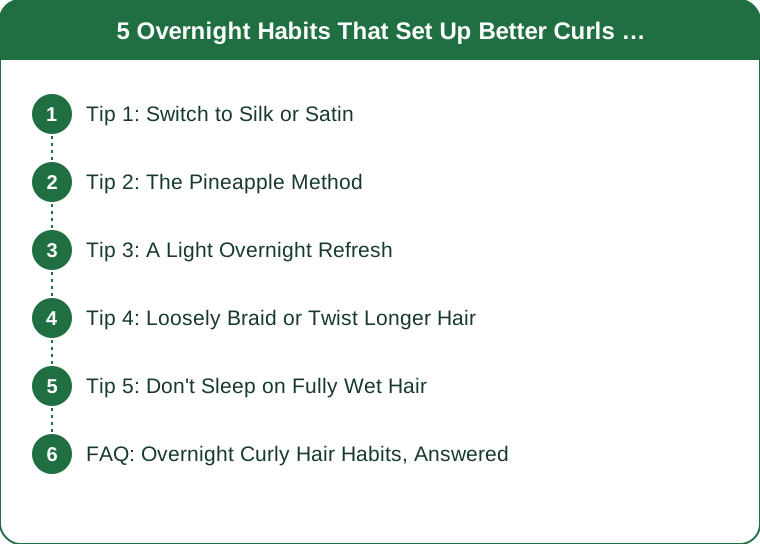
Tip 1: Switch to Silk or Satin
Cotton pillowcases and bonnets absorb moisture from hair and create friction that roughs up the hair cuticle overnight, both of which contribute directly to frizz — cotton fibers are rough at a microscopic level compared to silk or satin, and that roughness is what catches on the hair cuticle as you move through the night. A silk or satin pillowcase, or a silk bonnet/scarf wrapped around the hair, lets hair glide instead of catching, which preserves both moisture and curl definition significantly better by morning, and it’s a one-time purchase that keeps paying off every single night afterward.
Tip 2: The Pineapple Method
Gathering hair loosely at the very top of the head into a high, loose ‘pineapple’ ponytail (using a soft scrunchie, not a tight elastic) keeps curls from getting crushed flat against the pillow while still allowing the roots to keep some volume. This works especially well for medium-to-long curl lengths where the ends would otherwise drag against the pillow all night, and it takes under a minute to do right before bed, which is part of why it’s one of the most consistently recommended habits in curly hair care communities.
Tip 3: A Light Overnight Refresh
A small amount of leave-in conditioner or curl cream, lightly scrunched into the driest sections before bed, gives curls a bit of extra moisture to work with overnight rather than starting the night already dry from the day’s activity. This alone often reduces how much product is needed for the actual morning refresh, since the curls aren’t starting from a fully dried-out state the way they would without this step.

Tip 4: Loosely Braid or Twist Longer Hair
For hair long enough that pineapple-ing still lets ends drag on the pillow, one or two loose braids or twists (not tight) can protect length from friction while still leaving a soft, wavy definition to work with in the morning rather than flattened, tangled ends. This is particularly worth trying for anyone whose curls tend to tangle overnight regardless of the pineapple method alone, since the braid or twist adds an extra layer of physical protection along the full length of the hair.
Tip 5: Don’t Sleep on Fully Wet Hair
Going to bed with hair still significantly wet lets curls set in whatever random shape they land in against the pillow overnight, which usually means more tangling and a flatter result than air-drying or diffusing to at least damp before bed. Aim for hair that’s damp, not dripping, before any of the above overnight steps — this single timing adjustment often makes a bigger visible difference than any product change, since it addresses the root cause of a lot of morning frizz and tangling at once.
FAQ: Overnight Curly Hair Habits, Answered
Do I need to do all five of these every single night to see a difference?
No — the silk pillowcase or bonnet swap alone delivers a meaningful improvement on its own, and adding the pineapple method on top covers most of the remaining benefit; the other three are worth layering in gradually rather than treating as a mandatory all-or-nothing routine.
What if I don’t have a silk bonnet and can’t buy one right now?
A silk or satin scarf tied loosely around the hair works as a reasonable substitute, or in a pinch, sleeping on a silk or satin pillowcase alone covers most of the same friction-reduction benefit even without wrapping the hair itself.
How do I know if my curls are actually benefiting from these habits versus it being placebo?
Compare two mornings directly — one where you followed these habits and one where you didn’t — using the same wash-day starting point; most people notice a clear, repeatable difference in tangling and frizz within just one or two comparison nights, which is a strong sign it’s a real effect rather than imagination.
TL;DR:
- Swap cotton for silk or satin — pillowcase or bonnet, whichever you’ll actually use consistently
- Loose pineapple ponytail (soft scrunchie) protects curl shape without crushing volume
- A light leave-in refresh before bed gives curls extra moisture to work with overnight
- Loose braids or twists protect longer ends from pillow friction
- Get hair to damp, not soaking wet, before any overnight protection step
None of these require extra wash days or new products beyond what you likely already own — just a five-minute shift in the last step of your evening routine.
Keep Reading
This article is for general informational and styling purposes only. Fit, sizing, and product availability may vary.